
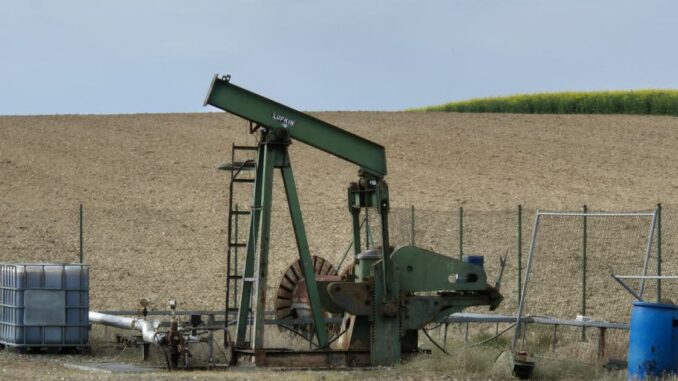
Motorists who regularly use the D246 probably pay little attention to it, especially when the corn has grown. At the northern entrance to Oberlauterbach, in the hollow of a valley, hidden between the plots, an oil pump. Familiar in northern Alsace until the 1960s, this type of installation has now almost disappeared from the landscape. Until recently, this pump was still in operation.
Even more surprising, it was operated by a single man, Philippe Labat. For nearly 30 years, this engineer based in the Paris region extracted oil.
The only independent operator in France to have its own well
His initial idea is based on an observation drawn from his career in the oil industry. “We earn a lot more money when we produce a barrel in France than when we produce it in Nigeria or Yemen,” explains the former Elf engineer. So I looked for what I could do that was simple and inexpensive. I set my sights on Alsace because it is where the oil is the shallowest in France: 600 meters compared to 1,500-2,500 meters in the Paris region and 3,000 meters in the Aquitaine Basin. »
Rather than drilling, which was too costly, he chose to take over an old well dug by Elf Aquitaine in 1983. The French oil company ended up abandoning it after three years, considering it dried up due to production in sharp decline (going from 50 to 2 barrels* per day).
Philippe Labat makes another hypothesis: the bottom of the well would be clogged with paraffin**, preventing the oil from rising. So he created a company called Oelweg (a company with 16 shareholders in which he held 50% of the shares), took over the well, and purchased, second-hand, a pendulum pump (from the Paris basin and obtained free of charge) as well as two tanks. Exploitation began in July 1999. This is the third oil field exploited in Alsace, the other two belonging to the Geopetrol company (in Scheibenhard and Eschau). The Parisian engineer then became the only independent operator in France to own a single oil well.
Very light management
To solve the clogging problem, Philippe Labat decided to heat the bottom of the well using electrical resistance. “But it didn’t work. » So for three years, production peaked at 5 barrels per day. “In 2002, I managed to lower a heater into the well,” says the engineer. The well went from 46 to 85 degrees and the flow rate increased to nearly 16 barrels per day. So it tripled. » A process which constitutes, according to him, a first in Europe on an oil well.
On the management side, it’s rather light: a very part-time employee (around ten hours of work per month) and the arrival of a tanker truck every three weeks to transport the oil to the Karlsruhe refinery, 25 km away. “I only came to Alsace once or twice a year for general meetings. »
The oil well is located north of Oberlauterbach, in the middle of fields. Photo Amélie Lécoyer
New wells authorized but drilling abandoned
In 2018, Oelweg obtained authorization to drill two additional wells within the concession. “The public inquiry did not receive any negative comments,” emphasizes Philippe Labat. But the project was abandoned when we realized that banks were no longer financing fossil fuels. »
A very profitable activity and resources for the village
After nearly 25 years of operation, the well produced a total of some 84,000 barrels (13 million liters) for a turnover of 4.3 million euros. “For an initial investment of 106,000 euros, it’s a great operation,” summarizes Philippe Labat simply.
An activity which also benefited the village of 550 inhabitants. Especially since the engineer, considering the mining royalty of around 1,000 euros per year “insignificant”, made “an annual donation of a few thousand euros to the municipality depending on the results of the exploitation. » “It ranged from 2,000 to 4,000 euros,” emphasizes Bruno Kraemer, mayor of Oberlauterbach since 2014. With these sums, far from being negligible on the scale of the municipality, we only purchased school materials. »
The end of an adventure
In October 2023, there is a breakdown. “The tube at the bottom of the well is stuck. We can’t get it out. » After several unsuccessful attempts to resolve the problem, Philippe Labat decided, last February, to launch the abandonment procedure. The well will then be filled with cement, the installations dismantled, and the land rehabilitated. Ultimately, nothing will allow us to know that oil was exploited in this place for 40 years.
But how much oil is left in this well today? “37,000 barrels or nearly 6 million liters to be released,” indicates Philippe Labat. And the 72-year-old added: “I have regrets of course, I would have liked to continue but life decided otherwise. » Even more so with current oil prices? ” Yes. The higher the oil price, the more money we made. I estimated that the breakeven point was at 35 euros per barrel. »
*A barrel of oil has a capacity of 159 liters, a unit of measurement born in Pechelbronn.
**Paraffin is a natural component of crude oil. When the oil cools, it creates deposits that can clog the well.
The end of hydrocarbon exploitation in France by 2040
In France, there are currently around sixty oil fields in operation, mainly in the Aquitaine and Paris basins. They produce 10 000 barrels per day, or almost 1 % of national consumption. Five companies share this market : Geopetrol (which operates the Alsatian wells), Bridge Energies, IPC Petroleum France, the Oil Production and Exploitation Company and Vermilion Rep.
Au 1is January 2025, France’s crude oil reserves represent a little more than 13 years of operation at the current rate, and approximately one and a half months of national consumption according to the Statistical Data and Studies Service. An observation which is part of a context of gradual exit from hydrocarbons. As a reminder, following the Climate Plan of Nicolas Hulot, then Minister of Ecological Transition, voted in 2017, any new hydrocarbon exploration or exploitation permit will be prohibited by 2040.
Leave a Reply