
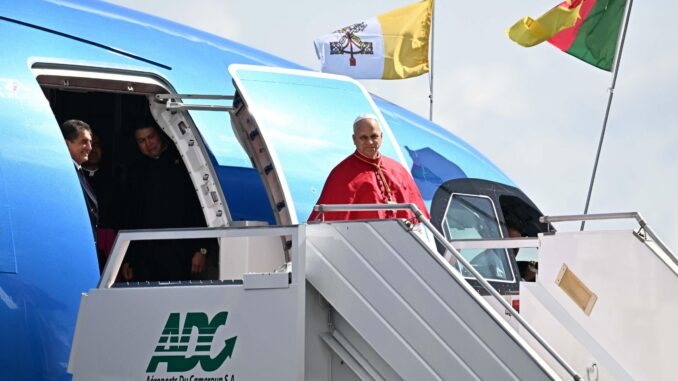
YAOUNDÉ, Cameroon.— This Wednesday, the Pope Leo XIV came to Cameroonthe second stage of his apostolic trip to Africawhere today will meet with the authorities and the bishops of the country and will visit an orphanage.
Coming from Algeriahe papal plane landed on the Yaoundé-Nsimalen International Airport where he was received by Prime Minister of Cameroon, Joseph Dion Ngute.
After the welcoming ceremony, the pontiff left for the Presidential Palacewhere he will have a meeting with the Cameroonian president, Paul Biyawho at 93 years old He has been in power for 43 years.
He Supreme Pontiff of the Catholic Church He will also give a speech before the authorities, civil society and diplomatic corps of this African country and will later visit the orphanage of Ngul Zamba.
Meeting for peace in Bamenda

The Pope will be in Cameroon until Saturday the 18th. Tomorrow, Thursday will move to Bamendaconflict-affected region in English-speaking areas, where he will participate in a meeting for peace.
On Friday the 17th there will be a mass in Douala, economic capital of Cameroonin which an attendance of 600,000 people is expected, and will also visit the Saint Paul Catholic hospitalwhile on Saturday will leave for Angolaafter a mass in the Yaoundé airport.
The bishop of Rome is the third pontiff to visit this African country after John Paul II (1985 and 1995) and Benedict XVI (2009).
After Cameroon, where Catholics make up 28% of the population, Peter’s successor will also visit Angola and Equatorial Guinea.
Leo XIV in Cameroon: asks to “love your neighbor, also in international relations”

YAOUNDÉ, Cameroon.- Pope Leo XIV launched a new and strong appeal: “The world thirsts for peace. ¡Enough of warswith its painful accumulations of deaths, destructions and exiles!” and assured that “the commandment ‘love your neighbor as yourself’ is also applicable in international relations.”
Speech to the authorities in Cameroon
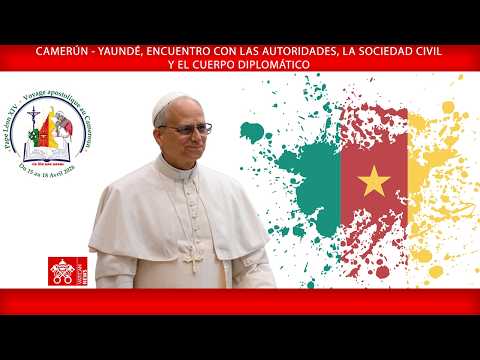
The pontiff spoke thus in his first speech to the authorities in Cameroonwhere he arrived this Wednesday from Algeria for the second stage of his African journey.
“This cry is intended to be a call to the will to contribute to authentic peace, putting it before any particular interest,” added the saint, who began his third international trip responding to the attacks of the president of the United States, Donald Trumpensuring that it would continue raising our voice against wars.
He explained that “we live, in effect, in a time in which resignation is spreading and the feeling of helplessness tends to paralyze the renewal that people deeply long for.” “How much hunger and thirst for justice! How much thirst for participation, for horizons, for brave decisions and for peace!” he added.
Leo XIV assured that his “great desire” is “to reach the hearts of everyone, particularly young people, called to shape, also politically, a more just world.”
In a speech addressed to the authorities of the sub-Saharan country but also focused on world leaders, he recalled his invitation “to humanity to reject the logic of violence and war, to embrace a peace founded on love and justice.”
“A peace that is disarmed, that is, not based on fear, threat or weapons; and disarming, because it is capable of resolving conflicts, opening hearts and generating trust, empathy and hope,” he described.
And he stressed that achieving peace “is the responsibility of everyone” but “first of all, of the civil authorities.”
“Governing means loving one’s own country and also neighboring countries; the commandment ‘love your neighbor as yourself’ is also applicable in international relations,” he asserted.
He also defended involving “religious leaders in mediation and reconciliation initiatives” because “politics and diplomacy can use moral forces capable of calming tensions, preventing radicalization and promoting a culture of reciprocal esteem and respect.”
And to the politicians and together with the president of the country Paul Biyawho at 93 years old is the oldest president in the world and has governed Cameroon since November 6, 1982, reminded them of the words of Saint Augustine“who, sixteen hundred years ago, wrote words of great relevance” and who said that “those who command are at the service of those who, according to appearances, are commanded.”
And he explained what he means to indicate that “serving one’s country means dedicating oneself with a lucid mind and complete conscience to the common good of all the people: the majority, the minorities and their mutual harmony.”
The Pope asks the leaders of Cameroon to examine their conscience and break corruption

Pope Leo XIV asked the leaders of Cameroon and “examination of conscience“, “transparency in resource management” and “break corruption“, in the speech he gave on the first day of his visit to the country during the event at the presidential palace before the head of state Paul Biya.
In a last-minute change, Leo XIV gave his speech at the presidential palace and before Biya, in the first act of his visit to Cameroon and the second stage of his African journey after arriving from Algeria.
The holy father recalled the wars in the country and the current civil conflict that broke out in 2017 between the Army and English-speaking independence insurgents, who consider themselves marginalized compared to the French-speaking central government. An occasion that served him to once again launch a call to stop all wars “with their painful accumulations of deaths, destruction and exiles!”
But then he reviewed the situation in the country, which many NGOs accuse of repression and violation of human rightsand stressed that “transparency in the management of public resources and respect for the rule of law are essential to restore trust.”
26.7% of Cameroon’s population lives in poverty
Despite Cameroon is rich in resources such as oil, gas or minerals26.7% of its population is in poverty, according to the World Bank (WB), mainly due to the corruption and authoritarianism of the Government.
“It is time to dare to examine one’s conscience and take a brave qualitative leap. Just and credible institutions become pillars of stability. Public authority is called to be a bridge, never a factor of division, even where insecurity seems to reign,” the pontiff stated.
And he added that, although security is a priority, “it must always be exercised respecting human rights, combining rigor and magnanimity, with special attention to the most vulnerable.”
Denouncement of corruption among population poverty
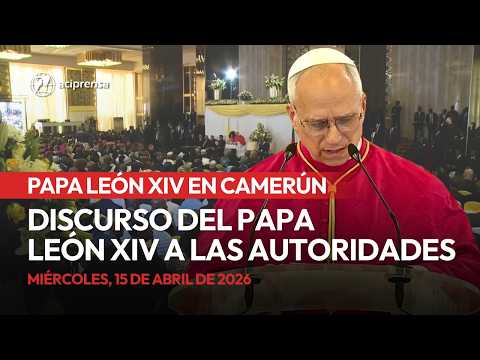
In a country with a high corruption ratewhich places it in 142nd place out of 180 in the Corruption Perception Index (IPC) prepared by International Transparencythe Pope recalled that the State must be “at the service of the people and especially the poorest” and that “a upright conduct in life“.
“For peace and justice to be strengthened, it is necessary to break the chains of corruption, which disfigure leaders, taking away their authority. It is necessary to free the heart from that thirst for profit that is idolatry,” he insisted.
He also defended the work of associations and NGOs, many of them blocked by the Biya Government.
“Associations, women’s and youth organizations, unions, humanitarian NGOs, traditional and religious leaders: they all play an irreplaceable role in building social peace,” he indicated.
“They are the first to intervene when tensions arise; they are the ones who accompany the displaced, support the victims, open spaces for dialogue and encourage local mediation,” Pope Leo XIV reminded the authorities gathered in the small hall of the palace.

He also thanked the role of women, who, “unfortunately, are the first victims of prejudice and violence, and yet continue to be tireless architects of peace.”
The Holy Father invited the country’s authorities to give them more weight in the decision-making processes because “their commitment to education, mediation and the reconstruction of the social fabric is unmatched and constitutes a stop to corruption and abuses of power.”
He defended African religious traditions, because “when they are not distorted by the poison of fundamentalisms, they inspire prophets of peace, justice, forgiveness and solidarity.”
And in a country where 50% of the population is Christian, with 28% Catholic, he urged encouraging ecumenical dialogue and involving religious leaders in mediation and reconciliation initiatives.
“Politics and diplomacy can use moral forces capable of calming tensions, preventing radicalization and promoting a culture of esteem and respect,” he stated.
You might also be interested: “Pope Leo XIV in Algeria: assures that a future of peace and changing history is possible”
Leave a Reply