
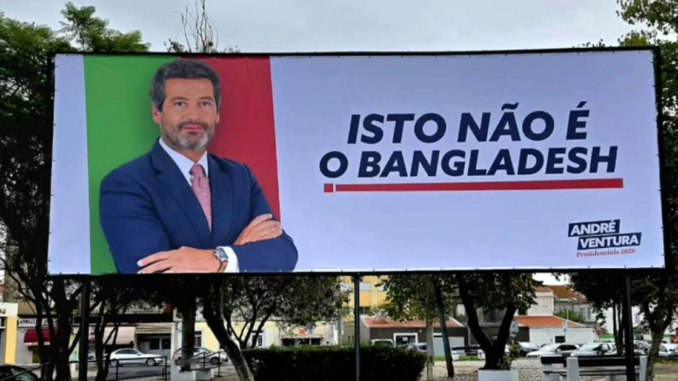
Author of one of the 51 complaints filed with the Public Ministry against André Ventura’s presidential campaign posters, SOS Racismo had already announced that it would react to the order of archiving, by the Public Ministry (MP), of the respective criminal investigation.
The reaction took place this Wednesday, through a request to open an investigation and the constitution of André Ventura as a defendant.
The news was communicated to DN by Nuno Silva, from the association’s management, adding that for now no further statements will be made: “The lawyers have already filed a request to open an investigation, and requested that André Ventura be indicted. We will now wait for the process to develop. As soon as possible, we will release more information.”
This request to open an investigation is the second reaction, by the complainants, to the shelving of the investigation, since the lawyer Antonio Garcia Pereira, who also filed a complaint against Ventura due to the aforementioned posters, had already been made publicon March 26, a hierarchical complaint (to the superior of the prosecutor of the Lisbon Department of Investigation and Criminal Action, Carlos Rodrigues, author of the archiving order), requesting that the decision be annulled and the investigation reopened, with the constitution of a defendant and the deduction of charges. In the opinion of Garcia Pereira and the lawyer who represents him, it is not legally possible to request instruction because there are no defendants.
In fact, Garcia Pereira accuses the prosecutor in question of “erroneous and blatant refusal to carry out any steps”, stressing that the archiving order is limited to the “formulation of evaluative and conclusive judgments and the assumption as if they were facts” when, he considers, “none were, due to the referenced omissive conductobject of proof.” For these reasons, considers that there was “a real and complete lack (although formally disguised as the opposite) of investigation or, at least, a more than reprehensible lack of promotion of the process by the Public Prosecutor’s Office”, which, according to the request for hierarchical intervention, constitutes “an irremediable nullity” to be declared ex officio by the superior.
Clash between civil justice and the MP’s perspective?
It is worth remembering that the MP, through prosecutor Carlos Rodrigues, in the order released on March 11, had decided to archive the investigation opened in November 2025 without carrying out any due diligence or naming defendants.
In fact, although the SOS Racismo complaint was filed not only against André Ventura, as the posters were from his presidential campaign, but also against other members of Chega – deputies Rui Paulo Duque Sousa, Marcus dos Santos and Pedro Frazão –, for having, on their official Facebook pages, reproduced “the content of the said posters”, in what the association considers to be an expression of “ostensibly insulting and defamatory prejudices and speeches”, offending “the dignity and moral integrity of the communities gypsies and immigrant communities living in Portugal” and imputing “to a group of people – described in terms of their national origin or cultural or ethnic belonging – facts and judgments offensive to their honor, dignity and consideration, through abusive and intolerable generalizations in a democracy”the archiving order never refers to those accused, focusing only on André Ventura.
The respective essential conclusion being that the posters in question, which read “Gypsies must obey the law”, “Immigrants cannot live on subsidies” and “This is not Bangladesh”, “there is no insult, defamation or incitement to practice discriminatory acts against a minority or vulnerable group, which is why it does not appear to be discriminatory for the purposes of criminal law”which concluded that “the crime reported was not fulfilled [Discriminação e incitamento ao ódio e à violência, previsto e punido pelo artigo 240.° do Código Penal] or any other.”
The prosecutor went so far as to state that the phrase “gypsies have to comply with the law” is “an apodictic proposition”, that is, an irrefutable, evident and logically demonstrable judgment or truth, which cannot be challenged, because “stating that a certain group of people has to comply with the law (…) corresponds to evidence”, with the “realized purpose of transmitting a message of a political nature and calling for public debate and for the presidential campaign the issue of integrating the Roma people into society.”
A very different understanding was reached by the Civil Court of Lisbon and, following an appeal by Ventura, the respective Court of Appeal (this in a ruling dated March 12), which, ruling on the request for the removal, by six gypsy citizens, of the poster about their community, considered it discriminatory.
“By proclaiming ‘gypsies have to obey the law’ the poster implicitly conveys the message that ‘gypsies do not obey the law'”said the civil court. “This is the immediately understandable meaning, which is why it contains a discriminatory message towards all people of a specific ethnic group, which historically and socially is recognized as being the object of widespread discrimination”. And he reiterated: “It is not the same thing to say that everyone has to comply with the law or that a certain group identified by their ethnicity, race, religion, origin, sex or sexual orientation has to comply with the law, because contrary to the general affirmation of equality before the law, the identification of a specific group as owing obedience to the law implies discrimination against that group before complying with the law.”
“Prosecutor ignored political and social context”, accuses Garcia Pereira
The decision of the civil court was therefore in the sense of the legality of the removal of the poster in question, and André Ventura, after hearing the Court’s ruling, drew attention to the contrast between this decision, which considers the poster to be illicit, and that of the Public Prosecutor’s Office, which saw nothing discriminatory in it, announcing that it would “go to the ultimate consequences”, appealing to the Constitutional Court (TC) and perhaps the European Court of Human Rights (ECtHR). But, as DN reported, would end up not presenting an appeal to the TC, letting the legal deadline pass and not giving, despite being questioned by the DN, any explanation about the change of mind.
In his request for hierarchical intervention, Garcia Pereira also alludes to the aforementioned contrast, noting that prosecutor Carlos Rodrigues ignored the existence of the first instance civil decision (when he closed the investigation, in January, the Lisbon Civil Court had already ordered the removal of the poster).
He also accuses the prosecutor of ignore “the entire extensive political and social context in which the placement [dos cartazes]moreover, in various public and highly visible spaces across the country, “violent attacks (as happened in the North of the country, Alentejo and Algarve) and even deadly attacks (as happened in Costa da Caparica) on immigrant citizens, particularly from Bangladesh, as well as gypsy citizens” occurred.and “horrible and degrading practices of persecution, humiliation and torture such as those occurring on intensive agricultural farms in Alentejo or in police stations and stations, such as PSP do Rato in Lisbon”.
Equally ignored by the prosecutor was, according to the aforementioned request for hierarchical intervention, the repetition by Ventura, “in an ostentatious and blatant way”, “of the speech that gypsies and immigrants do not comply with the law, they are even rapists and murderers, who come to our country to live off large social subsidies that are not paid to the Portuguese.”
Finally, Garcia Pereira accuses the prosecutor of invoking jurisprudence of the European Court of Human Rights “inapplicable in the case”, ignoring or “pretending to ignore” that the jurisprudence of that court “has repeatedly stated that freedom of expression, and in particular freedom of political expression, has limitsand therefore, through article 14 of the European Convention on Human Rights, cannot undermine the basic value of human dignity and the right to non-discrimination, particularly on the basis of race, ethnicity or origin, being precisely and exactly that – and not what the abusive and erroneously invoked order – that has been enshrined in the ECtHR’s Judgments, namely in the well-known and emblematic cases Bridinova e Chaparov v. Bulgaria, Zenmour v. France and, above all, Bring v. Belgium.”
MP was based on author against criminalization of hate speech
It is worth noting that the civil court decisions precisely invoke ECtHR rulings cited by Garcia Pereira.
These judgments analyzed (and criticized) in the work Political Ideologies and Criminal Law – The Problem of Hate Incitement in Political Conflictby professor at the Faculty of Law of Lisbon Nuno Igreja Matos, which in turn the order from prosecutor Carlos Rodrigues repeatedly cites to justify the filing.
Disagreeing with the jurisprudence of the ECtHR regarding the consideration that “freedom of political expression no longer deserves protection under article 10 of the European Convention on Human Rights [artigo que consagra a liberdade de expressão como direito humano] when it translates into generalized statements that attack or cast a negative light on ethnic groups, in line with the requirement to combat racial discrimination”Igreja Matos is dedicated to analyzing it, looking in depth at the ruling Bring v. Belgium.
In this ruling, the jurist writes, the criminal conviction in Belgium was at stake “of Daniel Féret, editor of a party publication and parliamentary member elected by the Front National party [de extrema-direita]through the distribution of pamphlets, programs and posters, all within the scope of an electoral campaign, which included expressions, imputations and opinions that associated the instability and insecurity of the population with acts carried out by refugees and illegal immigrantswith these positions adorned with provocative phrases about the government’s supposed inability to solve the problem. Due to these facts, the Belgian national courts sentenced Daniel Féret to a suspended prison sentence, subject to community work and, in addition, to a penalty of ineligibility for political office for a period of ten years for committing the crime of discrimination provided for in article 1 of the Loi du 30 juillet 1981, together with article 444 of the Belgian Penal Code, which punished any form of distinction, exclusion, restriction or preference with the effect of destroying, compromising or limiting the enjoyment of rights and conditions of equality, specifically, here, the incitement to discrimination, segregation, hatred or violence against a group based on race, color, descent or national or ethnic origin.” Conviction that the ECtHR validated.
There would hardly be a case analyzed by the Strasbourg judges with more jurisprudential relevance for the criminal investigation into the Ventura posters. However, prosecutor Carlos Rodrigues never mentions it, despite citing the work of Igreja Matos several times, and particularly his opinion, opposed to the ECtHR’s decision in Bring v. Belgium, of which Criminal Law must allow “greater expressive space in the face of speeches that prove to be substantively and intentionally political, taking care to sanction only manifestations devoid of these attributes”.
Furthermore, Igreja Matos considers that “incitement to hatred (in the sense attributed to it in the context of article 240 of the Penal Code) is not behavior that is even abstractly dangerous to the legal interests that it is intended to protect, its punishment being illegitimate”; “incitement to hatred is not sufficiently significant and harmful to legitimize the derogation of the right to freedom of expression, contrary to what occurs with behaviors that incite discrimination and incitement to violence.” Even with regard to incitement to discrimination, the criminal lawyer argues that, “When carried out in the context of a political speech, it is not a behavior of significant and harmful extent sufficient to legitimize the right to freedom of political expression and, as well, the democratic principle.”
It follows that in deciding to close the investigation into the Ventura posters, the Public Prosecutor’s Office was based on a author who opposes a substantial part of the criminal law whose application was under analysis and considers, contrary to European jurisprudence, that it should not, as a rule, be applied to political speeches.
Leave a Reply