
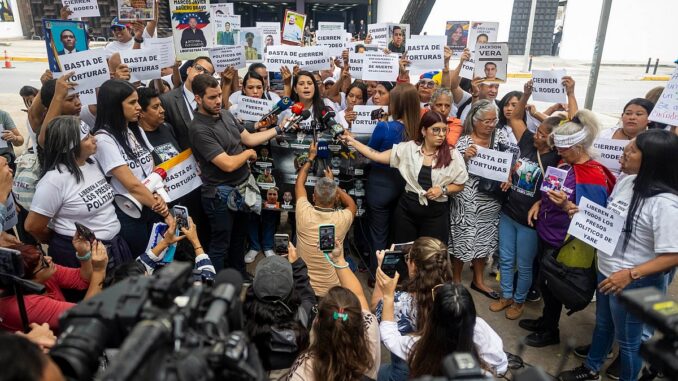
Relatives of political prisoners completed 100 days of vigils in front of Venezuelan prisons, where they await the release of their family members as part of the amnesty process that began in February. On January 8, five days after the capture of President Nicolás Maduro by the United States, the President of Parliament and head of Government negotiations, Jorge Rodríguez, announced the departure of a “significant number of people” as a “unilateral gesture” in favor of “peace and coexistence”.
One hundred days later – and two months after the approval of the amnesty – family members say that “lies, mockery, suffering and revictimization continue to prevail”as stated this Saturday by Andreína Baduel, from the non-governmental organization (NGO) Committee for the Freedom of Political Prisoners (CLIPP), outside Rodeo I, a prison near Caracas. The activist referred to the prison as a “torture center” where, “in the last ten days, the cruel treatment has intensified.”
Family members held sheets with the inscription “100 days waiting for”, followed by the inmate’s name, while chanting: “Justice, justice, justice and freedom. All are innocent, none are criminals.” Baduel said that, although they feel “immense pain and worry”, during this period “faith, resilience and dignity were strengthened”.
“Today, more than ever, we are convinced that we are doing what is right to save the lives of our own and we will not tire of demanding the full and immediate freedom of all political prisoners, an end to torture and justice,” he said. 14 days have also passed since the “arbitrary suspension of visits” to the activist’s brother, Josnars Baduel, son of Raúl Isaías Baduel, former Minister of Defense under Hugo Chávez and who died in prison in 2021.
The young woman warned that her brother’s life “is at risk”, due to the “torture he was subjected to”, which is why she demands proof of life and release. Rodeo I was the place of detention of Nahuel Gallo, from the Argentine National Gendarmerie military force, who was released in March. Gallo described the enclosure as a “place of psychological torture.”
The NGO Foro Penal, which leads the legal defense of political prisoners, updated this Saturday the number of detainees and indicated that there are currently 477 people behind bars, of which 111 are at Rodeo I. According to official data, more than eight thousand people were amnestied. Authorities have not yet published a list of the identities of those granted amnesty, despite a public request from the United Nations High Commissioner for Human Rights, Volker Türk.
Leave a Reply