
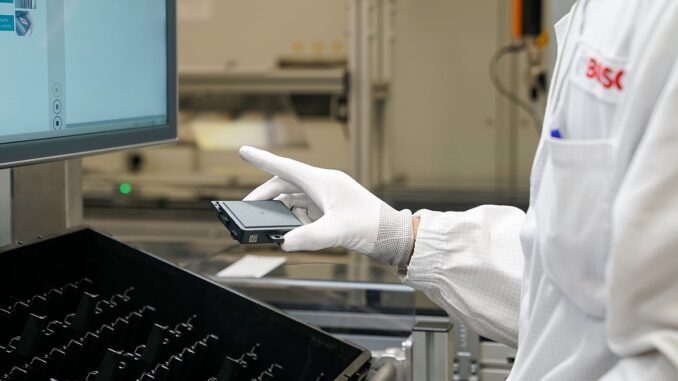
While manufacturing tests for this new generation are taking place, the Minas Gerais unit is manufacturing Generation 5 Plus and 5 Premium, and Generation 6 radars. This is a path that began in 2022, with the 5 Plus, and has grown to the point of Braga to be “the only Bosch unit to produce the Generation 6 radar”highlights Nuno Ribeiro, director of the group’s program. In these four years, more than 17 million radars have already left the Lomar factory and, this year, ten million units are expected to be manufacturedthe result of investment in the three new lines, which amounted to around 25 to 30 million euros, he says. It will be almost double the production recorded in 2025.
According to Nuno Ribeiro, “this year, we will be the factory with the largest production of Bosch radars”. As he highlights, “in these first three months of 2026 alone, we produced 40% of the total volume for 2025”. And he still emphasizes: “Since 2022, we have grown eight times in sales volume”. With the doubling of production (from three to six lines) there is also installed capacity to meet the expected market growth. This awaits Bosch, which has already noticed that OEMs (Original Equipment Manufacturer or, in Portuguese, original equipment manufacturer), are opting for radars instead of cameras or combining the two devices. This change is due to the ability of radars to work in extreme conditions of temperature (up to minus 40 degrees and plus 85) and light (in fog and darkness)explains. But not only. Radars are signal transmitters and receivers. Cameras only receive data.
These indicators illustrate Braga’s highly competitive position within the Bosch group. Especially because this Minho production center has as “competitors” the multinational’s factories in Germany, China and Mexico. In total, the four units have manufactured 100 million radars in the last 25 years and ensured market leadership in this business. Nuno Ribeiro explains the success of the Minho center by the efficiency and costs of the operation. As he emphasizes, “We have quality, we have competitive costs even to compete with China and we are very fast”.
Hernâni Correia, head of hardware development for the group in Braga, recalls that initially, Generation 5 sensors were sold on the market for 40 euros, but the price dropped by half as soon as the sixth generation sensors arrived. Currently, each unit is sold for 10 euros. Values that demonstrate the difficulty in gaining space in a highly competitive market. It is a single-digit margin business, which is supported by volume. And Braga asserted itself to be competitive in terms of costs and speed. It was even known as Braga Speedafter industrializing the Generation 6 radar in less than a year. It is a “rare” agility of response in this industry, points out Nuno Ribeiro.
On this path, the Bosch research & development center in Sequeira, Braga, has a unique brand. With 60 highly qualified employees, it is the nucleus responsible for innovation and testing of sensors. Predictive engineering is one of the main focuses. As Hernâni Correia explains, the development of a product like radar requires knowing the profile of drivers in the various countries where it will operate and sizing the equipment for all these markets. A science that requires mathematical calculations, various simulations and the testing of electromagnetic waves, to accurately measure distances and angles.
Bosch’s radar business in Braga is also boosting employment. As Lukas Wassermann, engineering director, says, “We want to hire between ten and 15 people in different engineering disciplines”. This official even emphasizes that Bosch has the objective “to create jobs and bring technology to Portugal”. And he summarizes: “This is a growing area.”
The Bosch complex in Braga, which opened in 1990, currently includes three production areas, three logistics warehouses and three development centers. The presence of the German multinational in Portugal also extends to Aveiro, Ovar and Lisbon, employing a total of 6880 people across the country. In 2024, Bosch’s Portuguese operation generated sales of 2.4 billion euros, with exports worth 97%. The accounts for the 2025 financial year will only be released in May. At a global level, the group recently reported that sales revenue reached 91 billion euros last year (still preliminary data), a slight increase compared to the 90.3 billion obtained in 2024.
Leave a Reply