
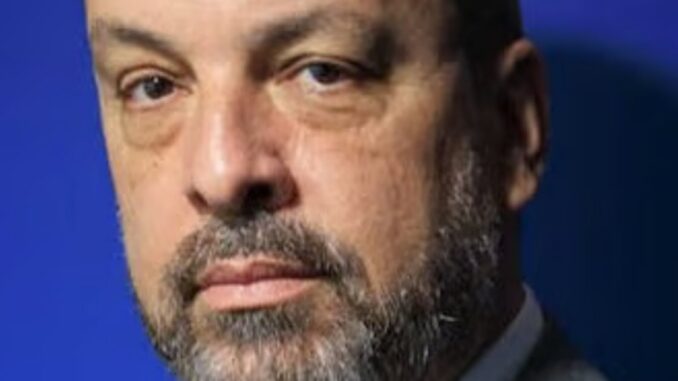
JD Vance, vice president of the United States, felt qualified to explain to Pope Leo XIV that his theology needed to be more rigorous. To the pope. To the Bishop of Rome. To the Vicar of Christ, as recognized by 1500 million Catholics.
The tradition that Vance claims to profess has a name for this disposition. Gregory the Great called her the queen of all vices. In Latin, pride. The incident would be just an episode of theological impertinence if it were not also a portrait. To understand the portrait you need to understand the model.
Vance was a Marine and served in Iraq as an Armed Forces journalist, but he did not build his public biography around direct combat. Without a prior political career, he was elected senator for Ohio in 2022 and left the position when he became vice president. Before that, he maintained public hostility towards Trump for years. The conversion was rapid, complete and politically functional. There was alignment. There was access to power. There was loyalty to ticket. What there was not was a public review of principles that rigorously explained the change.
Vance’s political career would not have existed without Peter Thiel. The co-founder of PayPal, an investor in surveillance and Artificial Intelligence, born in South Africa, was one of the main patrons of the new American technological right. Thiel financed the Senate candidacy, opened the door to the Silicon Valley ecosystem and helped build the political platform that made Vance’s vice-presidency possible.
Elon Musk, also born in South Africa, completes the picture. These are men who became powerful in the United States, but whose initial formation occurred in a hierarchical, white racial order, in which a minority ruled a black majority. When that order collapsed, there was left a political memory of loss and displacement that was never fully worked through. It is no coincidence that Thiel finances Curtis Yarvin, the neo-reactionary theorist who treats democracy as an obsolete system to be replaced by centralized and hierarchical power structures
It is at this point that the South African connection gains interpretative importance. The narrative of the persecution of the white South African community, which reached Trump through these circuits and which he enthusiastically adopted, should not be read simply as electoral propaganda. It must also be read as an emotional and political grammar of siege, dispossession and revengetransported to American space. The structural affinity between the social universe from which they came and the way they read the liberal order is too consistent to be ignored.
Vance presents himself as the face of MAGA, the spokesman for deep America, the defender of Ohio’s working-class communities against cosmopolitan elites. But its leading role in attacking European regulation, the Digital Markets Actto the AI Act and the European regulatory architecture on large technology platforms, is not just populism. It is also the political return on the investment made by Silicon Valley.
The America Vance represents is not just Ohio. It is that of servers, risk capital and a project of techno-feudalism in which the law is progressively replaced by the platforms’ terms of service. Whoever controls the algorithm doesn’t need to correct the pope. You can just turn it off.
Support for the German AfD confirms what the MAGA discourse tends to obscure. The AfD is not a generic populist party. It is a force of ethno-national identity, with roots in nationalism folkishand has been the subject of scrutiny by German authorities on suspicion of extremism.
Vance does not simply express sympathy for European social discontent. It aligns with a specific vision of belonging, borders and exclusion. The South African thread, the German thread and the American thread form the same weave here.
The religious contradiction completes the portrait. Vance has embraced Catholicism as his political identity, but his public reading of the faith seems increasingly subordinated to the convenience of power. When confronted with Pope Leo XIV’s position on the Middle East, he responded as if he believed himself qualified to correct the Church’s Magisterium, insinuating that spiritual authority should surrender to political logic.
Pride is not just a personal trait of JD Vance. It is the hallmark of a project. The project of a group that has accumulated enough technological capital to buy political influence, that carries with it a worldview shaped by historical experiences of hierarchy and loss, and that has found in MAGA the ideal vehicle to transform that vision into state power. Vance is the presentable face of this operation.
Gregory the Great classified the vice well. What he didn’t foresee was that the queen would have an investment fund, redemption language and an American passport.
Leave a Reply