
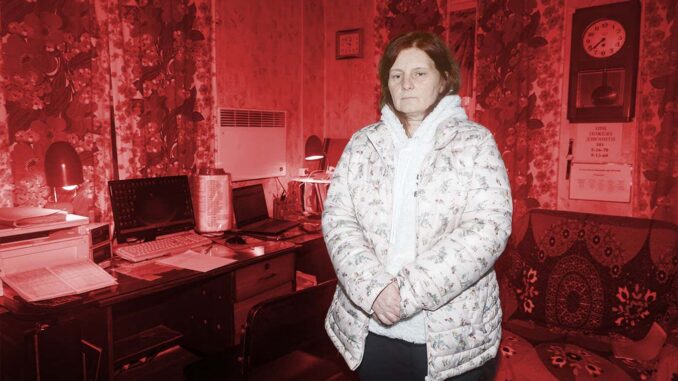
Lyudmila Dyblenko remained in Chernobyl during the Russian occupation in 2022
Mykhayla Palinchak
As Russian troops rolled across the Belarusian border into Ukraine on February 24, 2022, Lyudmila Dyblenko, head of the Chernobyl weather station, told her staff to pack up and run. But when she did, her own window of escape was closed; Russia occupied the closed zone around the power plant.
“I started collecting monitors and equipment, then it was too late,” Dyblenko says, speaking to me in the small cabin where the weather station is located. Although she had no choice but to cower at that moment, she heroically decided to continue taking vital measurements of radiation, temperature, wind, rain and other measurements that allow scientists to monitor the conditions at Chernobyl. “I decided to continue my work,” she says. “I really love my job and I really love my country.
The task of measuring and transmitting data is usually automated, but on March 9, its electricity supply was interrupted. This left her equipment unusable and heating and cooking virtually impossible. The hut is the warmest place I experienced during my stay in Chernobyl in the winter, with a fire on the go that made Dyblenko’s small table a comfortable place to work. It was a different story during the occupation.
Dyblenko carefully followed the plans of the Russian patrols, worked out their timing, and began slipping out to take measurements by hand, then transferred them to an old cell phone, which she found had a better antenna than modern smartphones. The weather station is located at the highest point of Chernobyl and discovered several nearby places – a truck park and a church – where it could find a weak signal and get its data off.
“I have software where you put data in and it automatically compiles and sends it, but it wasn’t possible [during the power outage]so I had to do it manually,” says Dyblenko.
Unfortunately, while Dyblenko was working, the Russian soldiers became emboldened. One finally broke into her house and demanded cognac. Deciding to treat him like a naughty schoolboy, she snapped, “Is this a restaurant?” Luckily it worked and he left with his tail between his legs.
She finally realized that there were constant patrols on her when she saw a tiny red dot of light in the bushes on the opposite side of the clearing where the scientific instruments were located. She decided not to look at it and continued as before.
Because of it, there is no gap in the data, which means that the scientific analysis of the Chernobyl Exclusion Zone can be complete and accurate – with no missing period of data during the occupation. Ukrainian President Volodymyr Zelenskyy awarded her a medal for her bravery, perhaps the only one a meteorologist will receive during this war, about which she speaks – quite rightly – with clear pride.
topics:
Leave a Reply