
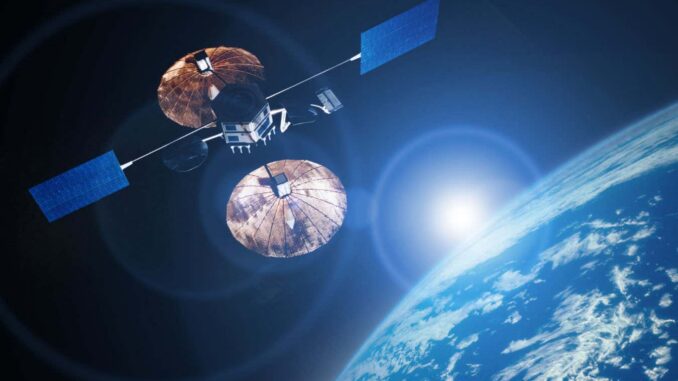
There may be a new way to control satellites in space
Mike_shots/Shutterstock
It may be possible to make space exploration missions last longer and avoid collisions between spacecraft using a technique that uses magnetic fields to move satellites.
Currently, most space missions and satellites have a limited lifespan because objects move through space using fuel, which often runs out. One alternative method, called Electromagnetic Formation Flying (EMFF), relies on renewable energy sources such as solar panels to power electromagnetic coils on board satellites. These generate a magnetic field which, through interaction with similar magnetic fields generated on any nearby satellite, can theoretically be used to maneuver the spacecraft.
But researchers have encountered problems using the EMFF to move objects in space because of a problem called magnetic coupling. The magnetic field generated by a satellite interferes not only with one nearby satellite, but with all the satellites around it, making it difficult to move more than two nearby satellites in a controlled manner.
A team of researchers from the University of Kentucky found a potential solution using a different approach, called Alternating Magnetic Field Forces (AMFF).
This approach allows two satellites to communicate and control their mutual movement without interfering with a third nearby satellite. To do this, the researchers used unique interaction frequencies, which means that two satellites can communicate and coordinate their movement on one frequency while simultaneously communicating with other nearby satellites on different frequencies.
The AMFF concept was tested on Earth rather than in space. The three satellites were placed on special linear rails that use high-pressure air to create a low-friction environment. The satellites were able to successfully interact with each other and move at precise distances defined by the researchers using built-in laser targeting modules.
The team behind the project did not respond to requests for an interview. But Alvar Saenz Otero at the University of Washington says the paper is a step forward in a long-standing field of research. “The complexity of formation flying systems requires a big jump from two units to three units,” he explains.
But Otero is less sure whether we’re likely to see it power satellites in low Earth orbit, including mega constellations of satellites like those that power Starlink. “Everything we’ve ever done for EMFF has always been about deep space operations,” he says.
Earth’s atmosphere, as well as the Moon and Sun, can create interference on the frequencies used for either EMFF or AMFF, he says.
And while three units can now fly in unison and move using magnetic fields, scaling them up to control the movement of thousands of satellites is a completely different task. “It’s not something that applies at the constellation level,” he says Ray Sedwick at the University of Maryland.
“The range over which the EMFF can operate is greatly increased if you use superconducting magnetic coils, but there are technical challenges,” explains Sedwick – suggesting that large-scale magnetic motion is still some time away.
topics:
Leave a Reply