
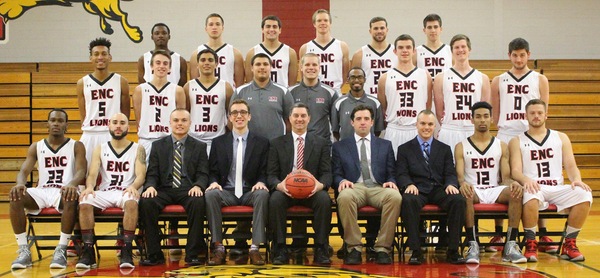

ENC men’s basketball team for 2016-2017. Scott Polsgrove is seen sitting holding the basketball. (Photo credit ENC Athletics Department)
The end of a season can mark the end of team’s journey to a championship. Other times it can offer a glimmer of hope as to what comes in the following season.
For the ENC men’s basketball team, a loss to Roger Williams last spring in the Commonwealth Coast Conference (CCC) playoffs marked the end of one era and the beginning of another. This era began with Coach Scott Polsgrove leading the way as the new ENC men’s basketball head coach merely three weeks after the resignation of Coach Jim Aller. Aller resigned after seven successful seasons as the men’s coach. Additionally, Polsgrove inherited a mixture of experience and youth as many of last year’s key contributors graduated.
This doesn’t seem to shake Polsgrove as he comments, “Every year is a new year, every team is a new team, even if you have a lot of the same players. I remember as a player at Taylor University, for our media day a reporter asked my head coach if he felt any pressure having won a championship last season. His reply was simple: ‘No, this a brand new team and we haven’t accomplished anything [yet].’”
Certainly, the Lions are a new team having more incoming players than returners in a 10-6 ratio, going into this season. Though the Men’s team was unable to win a championship last year, they did, however, enjoy one of their more successful runs having won 18 or more games for four seasons in a row for the first time in ENC history.
In the 2015-2016 school year, the Lions also the saw two players reach the 1,000 point mark: Eric Lynch and Jaylen Owens, both seniors.
Entering this season, the Lions have had to transition from a senior top-heavy team to a younger well-balanced team with many new additions.
“We are trying to build practice habits that become game habits,” Polsgrove says, “I say that a lot to the team. If we practice poorly we are more likely going to play poorly, so we have to stop and correct ourselves and keep trying to get better every day.”
Polsgrove’s push on good practices has shown, especially when it comes to free throws. The players have practiced free-throw shooting extensively, whether in official practice or on their free time, and it definitely showed in the November 19 game against MIT. The Lions shot 32 free throws with 81% accuracy, 15 of which were made by senior guard Christian Lynch.
Polsgrove’s coaching style was heavily influenced by many of his own coaches, including legendary Taylor University coach Paul Patterson who coached at Taylor University for 34 years.
Commenting on the different coaching techniques that impacted his own style, Polsgrove says “It’s a smorgasbord of different things I’ve learned over the years that has worked for me and hasn’t worked for me, so you could call it my system, but it’s really a product of what I learned from previous coaches.”
However, Polsgrove’s system has taken the time to catch on with the ENC’s men’s team, having a limited amount of practices before the season. As a result, Polsgrove runs an intense practice to make up for any lost time.
“If you’re not engaged,” Lynch says about practice, “you’re going to miss something and [your opponent is] going to get on you.” Lynch has played exceptionally well under Polsgrove, which Lynch credits to Polsgrove’s encouragement for him to be more aggressive on the court in getting to the basket. As a result, Lynch has increased his average points per game by nearly 10 points.
For Polsgrove, practice sessions are more like teaching classes as he tries to implement his system of basketball. Polsgrove’s biggest concern has been allowing offensive rebounds. The men’s basketball team is second to last in rebounding in the CCC, grabbing 36 a game. ENC has always struggled with rebounding as one of the ‘smaller’ teams in the CCC. ENC’s top rebounder, Corey Doran, sees rebounding as something the whole team needs to improve on.
“We just have to be better. You can’t win a championship like this,” said Doran on the team’s rebounding and defense.
On the offensive end, ENC looks more skilled than last year, utilizing Polsgrove’s coaching on ball and player movement. ENC is in the top five in both assists per game and offensive field goal percentage among the teams in the CCC.
While offense is strong, defensively ENC seems to struggle. The team’s effort defensively is not in question, but rather their understanding of where to be at the right time.
“We have given up way too much of our defensive field goal percentage to our opponents. I think that will get better once we gain a better understanding of my system and as the team develops a better trust for one another,” Polsgrove said.
Through 19 games, the team is 9-11 and is currently on a four-game losing streak. They rank fourth in the CCC with a record of 6-7 in conference games, including a big victory over top-ranked Nichols on January 11. Through more experience with Polsgrove’s system, the team could have easily been tied with Roger Williams and Endicott for first place in the CCC.
Records can be deceiving however, and ENC should know this more than any team, having entered Christmas break last year undefeated before losing their next five games and eventually losing in the first round of the CCC playoffs to Roger Williams.
With that being said, Athletic Director Brad Zarges offers keen insight as to what everyone should expect from ENC from his experience working with Polsgrove at King College for four years: “If I was in the conference, I would be a concerned to face ENC in the playoffs because by the end of the year we will see a consistently high performing, well-coached team on the court.”