
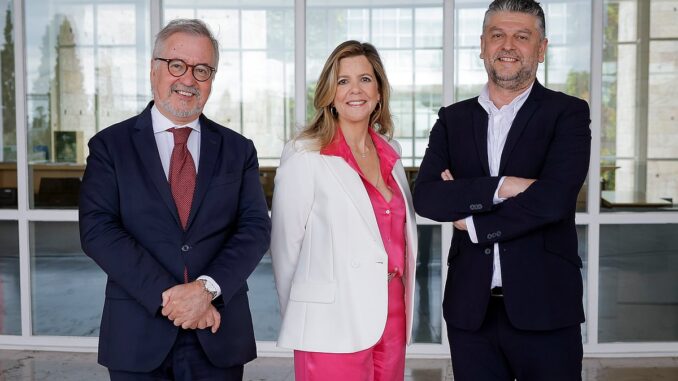
The Fundação Centro Cultural de Belém wants to open a new cycle in the life of the cultural institution and announced this afternoon, April 15th, the main guidelines for its activity until 2030. The institution chaired by Nuno Vassallo e Silva wants to attract new audiences, expanding its social base, gaining greater international relevance and diversifying its funding sources.
“The Centro Cultural de Belém has a unique place in Portuguese cultural life, but this place cannot just be inherited, it has to be renewed. We want a Centro Cultural de Belém that is more open, more desired, more legible, more international, more participatory and more sustainable. We want a Belém Cultural Center that continues to be a quality reference, but is also closer and more appreciable for citizens”, said Nuno Vassallo e Silva at the presentation of the Strategic Plan 2026-2030.
The plan entitled “Re-visit” is based on the values of “hospitality, diversity, freedom, participation and knowledge”, and on three strategic vectors: “European culture, new audiences and territorial curation”. These are guidelines, without quantitative targets, which will be worked on by the institution’s management, highlighted the CCB administrators.
Regarding “hospitality”, Rui Morais admits that this value caused some “strangeness”, but considers it to be fundamental. “From children, to concertgoers, to exhibition visitors, when they enter this house, they have to feel like they are in their home.” This will involve, according to the institution, new ways of traveling through the space, new signage, and the reinforcement of outdoor programming. The strategic plan talks about “lifestyle cultural” and in an approach “to the public’s desire lines”.
Nuno Vassallo e Silva explains that the public will be central to the programming: “The CCB continues to be recognized as a quality reference, but audiences today are asking for more and more. The challenge is no longer just to program for audiences, but with audiences.”
The CCB wants to attract younger generations and connect with what it calls “cultural diasporas”. “The Strategic Plan clearly assumes a preferential option for new audiences. But it is not just the younger generations that we want to win over. They are essential for the future, obviously, but we also want audiences from different cultures and languages. This, however, does not imply abandoning traditional audiences. However, once we have arrived here, Our ambition has to be greater and it is essential to expand the social base of the Belém Cultural Center. To do this, we have to think about the visitor experience in a much more demanding way. We have to make it more attractive”, says Rui Morais.
The institution wants to attract not only Portuguese people who live outside the country, but “all those foreigners who live in Portugal, many of them with intense cultural habits that lead them to see themselves in quality, demanding and careful programming”, says Rita Romão.
CCB’s plans for the coming years also include strengthening connections to the European university and polytechnic system. “To invest in a school of knowledge for the entire value chain of art and culture, which will also include an international artistic residency program for young students and creative professionals. In short, we want a more European, more international and, consequently, more influential Belém Cultural Center”, says Rui Morais.
The design of these artistic residencies is not yet “fully defined”, says the administrator, but the idea is to cover not only the artistic areas but also the technical-artistic areas, with a view to passing on knowledge. “We will work on these guidelines with the boards. We will also listen to the contributions of employees, and it is a plan that is growing.”
Another central point of the CCB’s strategic plan until 2030 is the diversification of financing sources. “There is a path to new models of philanthropy and this plan also assumes a need to create a professional team specialized not only in fundraising, but also look at all the applications for international competitions. Simply put, CCB wants to be stronger artistically, more socially open, and also more financially capable. Not to move away from its public mission, but to fulfill it better, with more means, more reach and a lower degree of dependence”, says Rita Romão.
The CCB receives 10.5 million euros annually from the Ministry of Culture, having managed in 2025 a budget of around 18 million euros (with around eight million euros of its own revenue). The institution’s objective is to strengthen these revenues by competing for resources and strengthening partnerships with the private sector. “We don’t have any relevant patrons or sponsors and we think this is an issue that needs to be addressed, needs to be resolved”, says Rui Morais.
The provision of spaces for holding events, congresses and meetings is also an important source of revenue for the CCB, but the occupancy of auditoriums, large and small, which last year was 55 days, will not be at the expense of programming, guarantees the institution’s administration. “Nowhere is this in the strategic plan, I would like to reaffirm that”, highlighted Rui Morais.
The focus on increasing own revenue and the path towards a “lower degree of dependence”, as Rita Romão said, does not mean that the objective is to receive less money from the State Budget. “With everything that the Belém Cultural Center represents, I would say that the State’s allocation is not exaggerated. What I think is that there is a capacity to seek another type of own revenue. Obviously, from a financial point of view, we do not advocate a reduction in the State’s contribution”, emphasizes Rui Morais.
Another of the objectives, which the construction of the new modules IV and V of the CCB (with hotel, commerce and services areas) will facilitate, according to Nuno Vassallo e Silva, is to take advantage of the institution’s location on the Belém-Tejo axis to attract more public and position the institution as a “reference destination in European cultural tourism”.
The work will allow, considers the CCB administration, a connection between the “historical legacy”, such as the Belém Tower, and the museum. “It will allow circulation, which has always been the principle idea of this axis, which comes from the monumental area and allows walking to the riverside area of Belém. For the Council, it is a privilege to have signed with Alves Ribeiro, who are our partners, the start of construction. The work is in the excavation phase and contains archaeological finds that were already known to be there.
The archaeological finds in question are from the Quinta Real da Praia (or Marialva) Palace. Nuno Vassallo e Silva says that a presentation was made to the president of the Lisbon City Council and that they are working with Património Cultural, IP, hoping that the project will be completed “between 2029 and 2030”.
Nuno Vassallo e Silva was asked whether he would allow an extreme right-wing event to be held again at the CCB, as happened in October 2025, when he hosted a meeting of the Patriots Foundation, which brings together European extreme right-wing parties, and which was contested by the Association of Visual Artists in Portugal.
“Regarding the issue of room rentals, the strategy itself is very clear, it is based on democratic values, the values that the CCB defends, this is a flag that we will not give up. From the point of view of tolerance, freedom, democratic and European values, which are what the CCB defends. The strategic plan enshrines them. Any commercial activity must respect the democratic values of the CCB. Whoever comes to a conference has to sign the contracts, the conditions, and these conditions are very clear”highlighted Vassallo e Silva.
Leave a Reply