
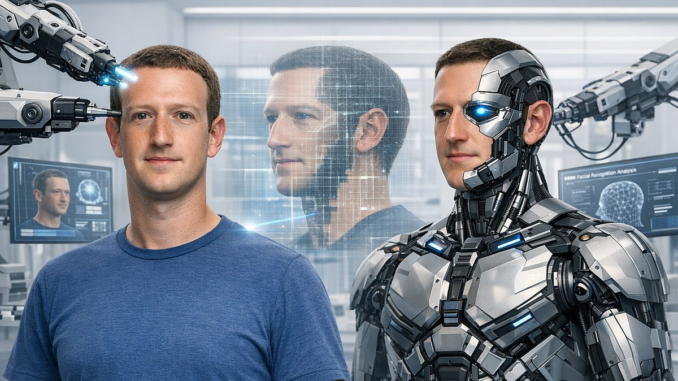
Any employee who has just joined a “junior” position at Meta – the owner of Facebook –, wherever he is in the world, has little chance of ever exchanging a word with his “boss”, the famous founder of the multimillion-dollar giant, Mark Zuckerberg. But that, starting this year, has changed: with a simple click, this employee can interact with a virtual (and photorealistic) Zuckerberg, who not only has the tone of voice and mannerisms of the original, but also knows in detail the company’s current strategy. And, the creators promise, it will be able to provide the answers and motivational support that the worker will need (for better or worse…)
This is the new flagship of the company that also owns Instagram, WhatsApp and Messenger, just to name the most popular. As reported this week by Financial Times and through the portal The Next Webo “clone digital” by Zuckerberg is being trained to serve as a direct “emotional and strategic bridge” between leadership and the North American technology company’s more than 79,000 employees.
The development of this avatar is in charge of Superintelligence Labs (MSL), an elite division of Meta that operates with an estimated budget of 15 billion dollars (around 12.71 billion euros). And unlike the chatbots rudimentary elements of the past, this clone uses the Muse Spark model, an evolution of the Llama architecture (the AI in open source of Meta) focused on what they call “native multimodality” – the system is designed to carry out multiple tasks simultaneously.
To create the “digital boss”, it was necessary to overcome the great technical challenge of latency. For a conversation to feel real, AI needs to process vision, audio and semantics in milliseconds, even if the user is thousands of kilometers away from the servers that are processing the information. MSL claims to have been able to eliminate noticeable delays by allowing the avatar to react to the employee’s facial expressions in real time.
But the most surprising thing – which is not only noteworthy from the point of view of marketing of the idea, given Zuckerberg’s status as a public figure that is both famous and controversial at the same time – is the involvement of the CEO himself in the project who, according to what was disclosed, will have spent between five and ten hours a week writing code and participating in technical review sessions to ensure that his “digital self” faithfully replicates his way of reasoning about the future of Artificial Intelligence.
The end result – to be put to the test in the real world, predictably, by the end of the year – is distinct from the so-called “CEO Agent”, a private productivity tool that Zuckerberg uses to summarize meetings and compress management layers. THE clone will be available to all company employees and focused on the company’s culture.
Other cases in Silicon Valley
Meta is not alone in this race for “digital chief,” but its approach is unique in scale and realism. Still, there are other leaders in the US who have already paved the way for the creation of the ever-present digital leader.
At Uber, Dara AI was created, a clone from CEO Dara Khosrowshahi that is voice and text-based so your employees can practice critical presentations. The goal here is “quality control”: whether the idea survives the feedback of this “synthetic Dara”, it is ready to move on to the next internal filter.
On LinkedIn (a Microsoft company), Reid AI, clone photorealist by co-founder Reid Hoffman, it is externally focused. Their goal is legacy preservation and knowledge dissemination, allowing their intelligence and investment philosophy to be available 24/7 for interviews and podcasts.
In the most valuable company in the world, Nvidia, Toy Jensen was created. CEO Jensen Huang uses (often stylized) digital avatars as technical interfaces, and Toy Jensen serves as a mentor who helps engineers navigate the company’s complex computing infrastructure.
Asia has taken algorithmic leadership to the extreme
It is outside the USA that the scenario of these digital leaders takes on even more disruptive proportions. In China, NetDragon Websoft didn’t just create a clone for conversations – named Tang Yu, an AI-based virtual humanoid, as its official CEO. It was a gimmick of marketing?
The fact is that while the clone While Zuckerberg says he wants to “humanize” remote work relationships, Tang Yu was designed to achieve “pure efficiency.” It analyzes performance metrics and makes management decisions without any emotional bias, operating as a digital brain that dictates the company’s rhythm. And act accordingly…
In South Korea, HYBE and SM Entertainment use clones of artists and executives to manage massive communities of fans, treating “digital presence” as a financial asset that can be infinitely multiplied.
Still on target: scalable cult of personality
What separates the Meta experience from the rest is the objective of the call “Personal Superintelligence“. Zuckerberg believes that the future of companies involves “flattening” hierarchies: if each employee has direct access to the founder’s vision (and AI will allow this), layers of middle management become less necessary. Furthermore, distortions or bad communications that these intermediaries introduce into the chain are avoided.
Basically, while Uber uses AI to train and China is using it to dictate, Meta is now trying to use it to “clone corporate culture”.
The risk, critics warn, is that interaction with a synthetic entity could end up creating a real leadership void, where charisma is processed by algorithms and human trust is replaced by a perfect photorealistic simulation. But to paraphrase an American expression: if it walks like a duck and quacks like a duck… Will it really make any difference?
Europe and the “digital bosses”: between industrial efficiency and the wall of the ‘AI Act’
While Meta is committed to digital charisma, the European ecosystem prioritizes digital twins of processes and worker legal security in the face of Artificial Intelligence.
A “Digital Zuckerberg”, as Meta is creating, would find a very different scenario in Europe from that of Silicon Valley. Instead of photorealistic avatars designed for “virtual cafes” or to create a false sense of proximity, the Old Continent is taking the path of “Leadership by Simulation”.
The case of Siemens is, in this context, the most comparable one found on this side of the Atlantic: under the vision of CEO Roland Busch, the German giant developed the Industrial Metaversewhere the concept of leader merges with data management. Here, the “digital leader” is not a face on a screen, but a Digital Twin of the Organization (DTO) that allows you to test strategic decisions — such as the restructuring of an assembly line in Portugal — in a virtual environment before any real execution. The priority is systemic effectiveness and not visual spectacle. Not exactly emotional closeness.
There is, however, a path with more human contours in Europe through companies like ElevenLabs. With roots in Poland and headquarters in the UK, this technology company has become the favorite tool for European CEOs managing global teams. Through clones With high-fidelity voice, leaders of large industrial groups can communicate with their factories and offices in more than 29 languages, maintaining their original intonation and emotional authority.
However, unlike Meta, this technology is used in Europe as an accessibility tool and never as a replacement for physical presence, always operating under a seal of transparency that identifies the synthetic origin of the message.
But would the Meta or Chinese NetDragon models be practically impossible to implement on European soil? Is that the “regulatory mountain” erected by the AI Act and by the GDPR it would prevent it. The rules of “transparency” in Europe are non-negotiable and any attempt to create a clone who impersonates the leader without explicit warning is punishable by fines that can paralyze an operation.
Furthermore, article 14 of the AI Act imposes the “human in the loop” principle, which immediately makes the existence of an “Algorithmic CEO” such as the Asian case of Tang Yu illegal for high-risk decisions such as promotions or dismissals.
Finally, the issue of biometric sovereignty protects both the leader and the employee. In the European Union, the data that makes up an individual’s voice and face is protected in such a way that the company cannot appropriate the “digital soul” of an executive after his departure.
In other words, while the USA and Asia race to automate the boss figure, Europe has chosen a path where AI even serves to optimize the factory and logistics, but at the top of the hierarchy, decision-making power and ethical responsibility remain exclusively in human hands. With all the good that this will have… or bad.
Leave a Reply