
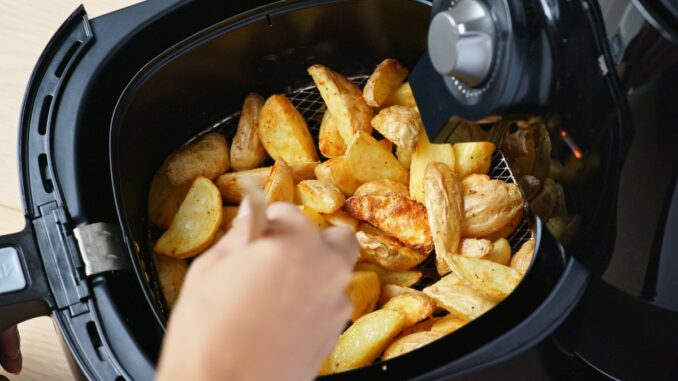
Adopted in thousands of homes, the air fryer has established itself as a “healthier” alternative to frying. But is this reputation really justified?
Presented as the “healthier” alternative to oil fryers, the air fryer, or hot air fryer, has established itself in millions of kitchens. But behind this promise, the scientific data invites nuance, explains Patricia Chairopoulos. The “health” journalist at 60 million consumers has just relied on several studies to “debunk” preconceived ideas about these oil-free fryers, also stars of social networks.
Is it really healthier than a classic fryer?
“It depends on what criteria”she warns straight away. The main argument, cooking “without fat”, is considered reductive. “The goal is not to eat absolutely no fat”recalls our expert, referring to a recommended intake of 30 to 35% of lipids in the diet by ANSES. Another bias: the products used. “Special air fryer” fries, for example, are often “more ultratransformed” than classic fries. “Why go for fries with this coating?”asks Patricia Chairopoulos. The device alone therefore does not guarantee a healthier diet.
What real health risks?
The investigation is based on several studies pointing to the formation of acrylamide, a substance which, linked to cooking at high temperatures, is classified as possibly carcinogenic for humans by the International Agency for Research on Cancer (IARC). “Air fryers can release more acrylamide than other cooking methods”underlines the journalist, particularly in the event of too high temperatures.
Another point of vigilance: non-stick bowls. While not considered harmful under normal conditions, they may contain PFAS. “As soon as the coating is damaged, it must be changed”she insists, comparing with stoves. Visible scratches or peeling coating are red flags. Patricia Chairopoulos also calls for vigilance regarding the quality of the devices: “Very cheap materials are not always a good sign”she warns, particularly recommending against second-hand purchases or on certain Chinese platforms such as AliExpress, where guarantees of compliance with European standards are more uncertain.
Do use and maintenance change everything?
It’s even central. “It all depends on how you maintain it”summarizes Patricia Chairopoulos. A poorly cleaned device, with carbonized residue, can “release even more pollutants” under the effect of heat. The problem is little perceived by consumers: “We tell ourselves that it’s a closed tank, there’s no reason”she notes. However, abnormal odors or fumes can indicate clogging. Ventilation, regular cleaning and precautions remain essential.
Does the air fryer encourage a form of “false good conscience” about food?
“Yes, absolutely”says Patricia Chairopoulos. The air fryer can induce a bias: “We tell ourselves that it’s good, so we pay less attention to the rest”. By focusing on one cooking method, some people relax their overall vigilance over food. The device is therefore neither to be banned nor idealized. “It depends on the use”summarizes the journalist.
What to avoid doing
- Large pieces of meat: they may appear well browned on the outside but remain insufficiently cooked inside, with a health risk.
- Foods that leak or become clogged (soft cheeses, fatty preparations): they complicate cleaning and encourage the accumulation of residue.
- Cooking at very high temperatures or for too long: they increase the formation of undesirable compounds such as acrylamide.
- A poorly maintained device: carbonized residues can, in the long run, lead to more pollutant emissions.
Leave a Reply