
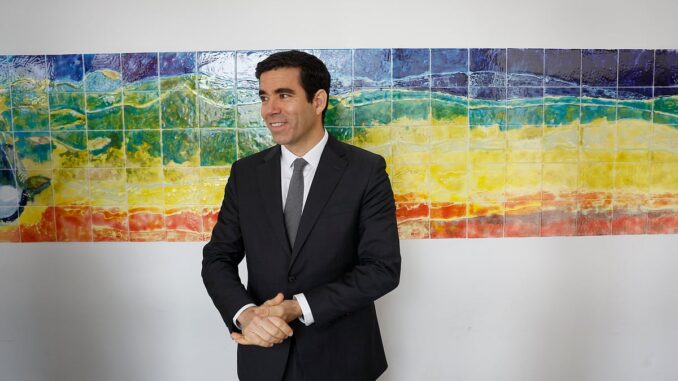
The Minister of the Presidency stated this Saturday, in Penamacor, at the opening of the Congress on Journalism, as part of the 80th anniversary of Jornal do Fundão, that the State can help the media without creating dependence.
“I don’t want a political power that creates dependencies on the media. On the contrary, if there is this risk, we will remain silent, because a democracy cannot live without professional, quality, free, independent media”, said Antônio Leitão Amaroremembering that “there is an element of counterpower in the media that is healthy. Sometimes uncomfortable, sometimes inconvenient, but totally indispensable to democracy.”
And “more than good intentions”, he wanted to bring “concrete measures”, because “there are not many areas as sensitive in democracy as this one. Because the line between wanting to do something to support and creating dependencies is a fine line”.
Tutor of the action plan for social communication, created by the current Government, the minister says he is attentive “to the challenges of sustainability, due to digital and technological transformation, changes in consumption habits and the channeling of resources”.
For paper newspapers, “the first measure we took in 2025 was to double Porte Pago financing, from 40 to 80 percent of the cost of postal distribution, plus 4.5 million euros that were invested in the sector”. And “independence is not lost, because it is not the State that chooses the subscribers”.
After the threat of Vasp to stop distributing printed publications in the interior of the countrythe minister adds that “a relevant amount is in the State budget to finance the distribution of newspapers at newsstands”, because “we cannot run the risk of closing access to newspapers to the interior”. But also in this case “the State is not deciding what the consumer choices are, nor the editorial preferences”.
As for sustainability, “a law was generally approved in Parliament yesterday that obliges public entities to advertise and buy advertising, in regional and local media, for their relevant events, such as, for example, projects involving European funds”, says the governor.
Another similar diploma, also approved, “is the mandatory advertising of municipal deliberations in the regional and local media, something that has been in the law for decades, but has never been implemented”. And, “in the same legislative initiative, there is an obligation for airtime to reach regional and local radio stations, not only in municipal elections, but also in legislative, presidential and European elections”.
In addition to these measures, “there is another law in Parliament, proposed by this Government, which is the figure of patronage for the media. If a newspaper or radio creates a product of cultural interest, it can be supported by private parties and this will result in an increase in terms of tax benefits for the patrons”.
Leitão Amaro also referred to the importance of professional self-regulation for journalists. “We must find ways, within the same spirit of independence, to strengthen the capacity for self-regulation and access to training”.
Nuno Francisco, director of Jornal do Fundão, recalled that “the digital ecosystem has brought multiple implications for the profession, such as the acceleration of journalism, with profound changes in the mediation processes and business models that, historically, supported the press”, arguing that the future of journalism “is an issue that depends on the entire society and all democratic regimes”.
Leave a Reply