
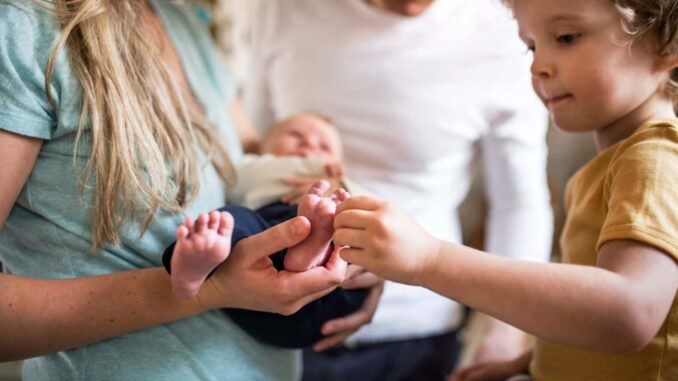
Many stereotypes surrounding sibling structures don’t stack up, but being the first or second child in a family can actually affect your health
iStockphoto
In a two-child family, whether you were born first or second can affect your chances of developing more than 150 diseases, according to the largest study of its kind. Researchers analyzed data from more than 10 million siblings and found links between birth order and everything from autism and anxiety to hay fever.
Birth order has fascinated scientists for more than a century, with attempts to identify connections with personality traits and IQ. However, many older studies have been criticized for cherry-picking data or failing to control for confounding factors.
ON orientation study in 2015 headed by Julia Rohrer at the University of Leipzig in Germany analyzed data from 20,000 children that took these issues into account. Birth order was found to have almost no effect on personality and only a small association with IQ—a drop of 1 to 2.5 IQ points between older and younger siblings.
The new analysis took a different approach and focused on the likelihood of different conditions developing. Benjamin Kramer at the University of Chicago in Illinois and his colleagues first compared 1.6 million sibling pairs by matching first-borns from one family with second-borns from another family, according to sex, year of birth, parental age, and sibling age difference. This allowed them to mitigate some confounding factors, such as the effect of how parents might treat their first and second child differently. They also compared genetically related siblings from 5.1 million families.
Of the 418 medical conditions, 150 showed an association with birth order. Of these, 79 were more common in first-borns and 71 were more common in second-borns.
The strongest associations for first-born children included several neurodevelopmental conditions, such as autism and Tourette syndrome, and cases of childhood psychosis. They also had a greater risk of acne, allergies, hay fever and anxiety disorders. Conversely, second-borns showed an increased risk of substance abuse, shingles, biliary tract disease (such as gallstones), gastritis (inflammation of the stomach lining), and migraines.
“Overall, it looks like a really careful study,” says Rohrer. But he cautions that the associations are modest — first-borns appear to have a 3.6 percent relative increased risk of depression, for example — and the results by no means allow for deterministic claims. “We will observe each person in only one position according to birth order. We will never know how their life would have turned out differently in another position,” he says.
The team also explored some potential mechanisms that could underpin the findings. For example, the increased risk of allergies and hay fever in first-born children can be explained by the “friendly enemy” hypothesis, in which later-born children experience greater microbial exposure from older siblings at an early age, which promotes increased immune tolerance. Consistent with this idea, only the oldest of two children was less likely to have allergies or hay fever as the age gap between them and their younger sibling widened.
A similar pattern emerged for substance abuse, with the increased risk among second-borns diminishing as age differences widened. The authors link this finding to research showing that later-born children exhibit increased risk-taking behavior, but Rohrer says much of this evidence has proven to be inconclusive and suggests that it might be more so Those born later may be overrepresented in careers that can expose people into multiple drug environments.
The team also suggests that the higher prevalence of autism in first-borns may reflect a combination of biological and environmental factors. Some research suggests that the mother’s immune system reacts more strongly in first pregnancies, for example, which can affect the development of the fetus’s brain. Sometimes, parents with one autistic child stop having more childrenmeaning that there may be a potential unknown bias in families who decide to have another child after the first has been diagnosed.
Another interpretation is “diagnostic substitution,” says Rohrer. “Diagnoses of ADHD and autism are partly dependent on psychometrically assessed intelligence [such as through IQ tests] – the same [autistic] behavior may be diagnosed as intellectual disability combined with reduced intelligence, but as ADHD combined with average intelligence,” he says. Since firstborns tend to have slightly higher IQs, they may be “more likely to end up with one diagnosis and later born more likely to end up with another diagnosis, despite the same symptoms.”
Ray Blanchard at the University of Toronto in Canada suggests that results might differ if sibling sex or only children were considered. For example, his research suggests that older brothers slightly increase the likelihood of homosexuality in later-born boys. This can be explained by the fact that mothers in their first pregnancies develop antibodies against male-specific proteins that alter the immune system and subtly influence the sexual orientation of later-born sons. “These apparent differences have turned out to be very important in birth order and sexual orientation research,” Blanchard says, adding that she thinks sibling sex order should be included in research like Kramer’s.
Leave a Reply